


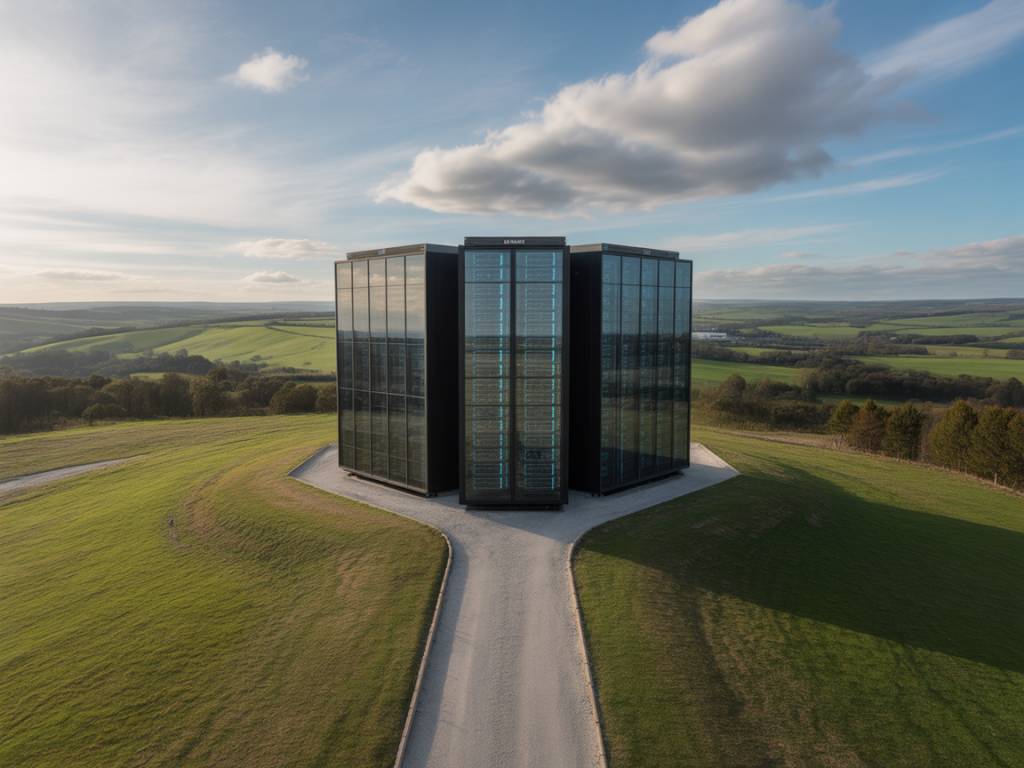
Every time you stream a video, send an email, or run an AI query, a data center somewhere consumes electricity — a lot of it. The global data center industry now accounts for roughly 1–1.5% of worldwide electricity consumption, and that share is climbing fast. With hyperscale facilities multiplying and AI workloads intensifying, the question is no longer whether the industry must go green, but how quickly it can get there. Powering data centers sustainably through renewable energy has shifted from an aspirational talking point to an operational imperative.
Why Powering Data Centers Sustainably Is Urgent Right Now
The numbers are hard to ignore. The International Energy Agency (IEA) estimates that data centers consumed approximately 200 TWh of electricity in 2020. By 2026, that figure could double as AI model training, cloud adoption, and edge computing accelerate demand. A single large-scale hyperscale facility can draw 100–200 megawatts of power — enough to supply tens of thousands of homes.
Beyond sheer volume, the carbon intensity of this electricity matters enormously. In regions still dependent on coal or gas grids, operating a data center can generate hundreds of thousands of tonnes of CO₂ annually. Switching to renewables doesn’t just cut costs; it fundamentally changes the environmental profile of digital services at scale.
The Role of Renewable Energy in the Digital Age: Core Sources
Not all clean energy sources serve data centers equally. The most impactful options combine scalability, cost-effectiveness, and reliability — three criteria that have shaped industry procurement strategies over the past decade.
Solar Power
On-site photovoltaic (PV) arrays and off-site solar farms are increasingly standard features of modern data center campuses. The levelized cost of solar energy (LCOE) has fallen by over 89% since 2010, making it one of the cheapest electricity sources available in sunny regions. Google’s data center in Henderson, Nevada, for example, draws directly from dedicated solar installations to cover a significant portion of its load.
Wind Energy
Wind power, both onshore and offshore, offers strong capacity factors and predictable long-term pricing. Through Power Purchase Agreements (PPAs), data center operators can lock in wind-generated electricity at fixed rates for 10–20 years, insulating operations from utility price volatility. Amazon Web Services has become one of the world’s largest corporate buyers of wind energy through this mechanism.
Hydroelectric and Geothermal Power
Iceland has built an entire data center ecosystem on the back of its virtually 100% renewable grid, combining geothermal and hydroelectric sources with naturally cold air for free cooling. Similar strategies are deployed in Scandinavia and parts of the Pacific Northwest, where clean hydropower is abundant and cooling costs are minimal.
Power Purchase Agreements: The Financial Engine Behind the Transition
The most transformative financial instrument driving sustainable data center energy procurement is the Power Purchase Agreement (PPA). These long-term contracts allow data center operators to directly fund the development of new renewable projects — wind farms, solar parks — even when those assets sit hundreds of miles away.
- Physical PPAs deliver electrons directly from a renewable facility to the data center via dedicated transmission lines or local grid infrastructure.
- Virtual PPAs (VPPAs) operate as financial contracts: the data center pays a fixed « strike price » for renewable energy on paper, while drawing grid power locally — effectively offsetting emissions at scale.
- Price stability is a major draw; with PPAs, operators avoid exposure to fossil-fuel-driven wholesale electricity market swings.
- Additionality matters too — well-structured PPAs stimulate new renewable capacity rather than simply claiming credit for existing projects.
Microsoft, Google, and Meta have collectively signed dozens of gigawatts worth of PPAs globally, making the tech sector one of the primary drivers of new renewable energy construction worldwide.
Technologies Making Sustainable Data Centers Possible
Procurement alone isn’t sufficient. Technological innovation inside and around data centers plays an equally critical role in making Powering Data Centers Sustainably a reality rather than a marketing claim.
Battery Energy Storage Systems (BESS)
Solar and wind are intermittent by nature. Battery storage bridges the gap, storing surplus generation and dispatching it during peak demand or low-production windows. Utility-scale lithium-ion and emerging iron-air battery systems are increasingly co-located with data center campuses to ensure 24/7 clean energy availability — a standard that net-zero annual accounting alone cannot meet.
AI-Optimized Cooling
Cooling typically accounts for 30–40% of a data center’s total energy use. Google’s DeepMind AI reduced cooling energy consumption at its data centers by up to 40% by dynamically managing airflow, temperature setpoints, and server loads in real time. Liquid immersion cooling and direct-to-chip cooling are pushing efficiency further, with Power Usage Effectiveness (PUE) ratios approaching 1.1 — near thermodynamic perfection.
Modular and Edge Design
Modular data centers can be deployed closer to renewable energy sources rather than forcing generation to travel to fixed, legacy locations. Edge facilities reduce transmission losses and enable localized renewable integration, creating a more resilient and lower-emission distributed infrastructure.
Strategic Location: Matching Data Centers to Renewable Resources
Geography is destiny in the energy world. Forward-thinking operators now assess renewable resource maps before selecting construction sites, rather than optimizing purely for land cost or network latency. Key location criteria include:
- Solar irradiance levels — the American Southwest, Southern Europe, and North Africa offer exceptional solar density.
- Wind capacity factors — coastal and offshore locations in Northern Europe and the US Midwest consistently outperform inland alternatives.
- Grid carbon intensity — regions with already-clean grids (Scandinavia, parts of Canada) provide immediate emissions benefits without heavy on-site investment.
- Ambient temperature — cooler climates reduce mechanical cooling demand, multiplying the efficiency gains from renewable integration.
Challenges That Still Stand in the Way
The transition is well underway, but it is not frictionless. Several structural obstacles continue to slow progress:
- Intermittency and storage gaps: Achieving true 24/7 carbon-free energy requires matching every hour of consumption with clean generation — an analytically complex and costly goal.
- Grid infrastructure bottlenecks: In many regions, transmission networks were not designed to carry large volumes of distributed renewable generation, creating congestion and curtailment issues.
- Regulatory fragmentation: Energy market rules vary dramatically between countries and even states, complicating cross-border PPA structures and grid interconnection approvals.
- Water consumption: Many cooling systems rely on significant water volumes — a sustainability trade-off that operators in water-stressed regions must actively manage.
Economic and Environmental Returns of Going Renewable
The business case for sustainable data center energy has never been stronger. Beyond regulatory compliance and reputational gains, the financial fundamentals are compelling:
- Lower long-term OPEX: Renewable energy carries near-zero marginal fuel costs once infrastructure is in place, contrasting sharply with volatile gas or coal pricing.
- Carbon credit and offset value: Companies generating surplus clean energy or holding verified Renewable Energy Certificates (RECs) can monetize these assets or use them to meet Scope 2 emission targets.
- Investor and client confidence: ESG-focused investors and enterprise clients increasingly require suppliers to demonstrate credible decarbonization roadmaps — sustainable energy procurement is a commercial differentiator.
- Resilience against carbon pricing: As carbon taxes expand globally, locking in renewables today reduces future exposure to escalating compliance costs.
What the Future Looks Like for Renewable-Powered Data Centers
The trajectory is clear: the data centers of 2030 will look radically different from those of 2015. Industry leaders are already piloting hydrogen fuel cells as backup power to replace diesel generators, exploring small modular nuclear reactors (SMRs) as always-on clean baseload, and deploying sophisticated time-matched energy procurement platforms that verify hourly renewable sourcing in real time.
Powering Data Centers Sustainably: The Role of Renewable Energy in the Digital Age is not a future aspiration — it is an active engineering and policy challenge being solved right now, facility by facility, megawatt by megawatt. The companies that move fastest and most comprehensively will set the standard for what responsible digital infrastructure looks like in a carbon-constrained world.